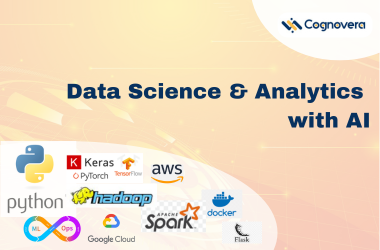
Data Science & Analytics with AI


- Description
- Curriculum
- FAQ
- Notice
- Reviews
The Data Science & Analytics with AI course is designed to provide learners with a deep understanding of data analysis, machine learning, artificial intelligence, and big data technologies. This comprehensive program covers everything from data preprocessing and statistical analysis to machine learning, deep learning, natural language processing (NLP), and AI model deployment. By the end of this course, learners will be equipped with the skills needed to solve real-world problems using data-driven decision-making and AI-powered solutions.
The course begins with Python programming, covering essential libraries such as NumPy, Pandas, Matplotlib, and Seaborn for data manipulation and visualization. Learners will explore exploratory data analysis (EDA), probability, statistical inference, and hypothesis testing, which are crucial for making data-driven decisions. The course then dives into machine learning, covering both supervised and unsupervised learning techniques, including regression models, classification algorithms, clustering, and model evaluation techniques.
A significant focus of the course is on deep learning and AI, where students will gain hands-on experience with Artificial Neural Networks (ANN), Convolutional Neural Networks (CNN) for image processing, and Recurrent Neural Networks (RNN) & LSTMs for time series forecasting using TensorFlow and Keras. The Natural Language Processing (NLP) module introduces text analytics, sentiment analysis, and transformer models such as BERT and GPT, allowing students to build AI-powered chatbots and automated text processing applications.
Additionally, learners will explore Big Data Analytics using Hadoop and Spark, as well as cloud-based AI model deployment on AWS and Google Cloud. The course also covers MLOps (Machine Learning Operations), CI/CD pipelines, and model deployment using Flask & Streamlit, ensuring that students can build, manage, and deploy AI solutions in production environments.
Throughout the course, students will work on real-world projects, including predictive analytics, fraud detection, AI-powered recommendation systems, image recognition, and NLP-based chatbot development. These hands-on projects will help learners build a strong portfolio, making them job-ready for roles such as Data Scientist, Machine Learning Engineer, AI Engineer, and Big Data Analyst.
By the end of the course, participants will have mastered data science, machine learning, and AI techniques, gaining expertise in data analytics, predictive modeling, deep learning architectures, and AI-driven applications, making them highly competitive in the growing field of artificial intelligence and data science.
-
1
 Day 1-2: Introduction to Cloud Computing
- What is Cloud Computing?
- Cloud Service Models (IaaS, PaaS, SaaS)
- Public, Private, and Hybrid Cloud
- Overview of AWS, Azure, and Google Cloud
-
2
Day 3-4: AWS Global Infrastructure & AWS Free Tier Setup
- AWS Regions & Availability Zones
- Setting up AWS Free Tier Account
- AWS Management Console Overview
- Billing & Cost Management
-
3
Day 5-6: Amazon EC2 (Elastic Compute Cloud)
- What is EC2? Instances & Pricing Models
- Launching EC2 instances (Linux & Windows)
- Configuring Security Groups & Key Pairs
- Elastic Load Balancing (ELB) & Auto Scaling
-
4
Day 7-8: Amazon S3 (Simple Storage Service)
- Introduction to Object Storage & S3 Buckets
- S3 Lifecycle Policies & Storage Classes
- Versioning & Access Control Lists (ACLs)
- Hosting a Static Website on S3
-
5
Day 9-10: Amazon RDS & DynamoDB
- Introduction to Amazon RDS (Relational Database Service)
- Creating & Managing RDS Instances (MySQL, PostgreSQL)
- DynamoDB (NoSQL Database) Overview
- Data Replication & Backup Strategies
-
6
Day 11-12: AWS Networking & Identity Management
- AWS VPC (Virtual Private Cloud) – Subnets, Routing, NAT, VPN
- AWS IAM (Identity & Access Management) – Roles & Policies
- AWS CloudFront (CDN) & Route 53 (DNS Management)
-
7
Day 13-14: AWS Lambda & API Gateway
- Introduction to Serverless Computing
- Creating AWS Lambda Functions (Python, Node.js)
- Event-Driven Computing with AWS Lambda
- Deploying APIs with Amazon API Gateway
-
8
Day 15-16: AWS CloudFormation & Infrastructure as Code (IaC)
- Introduction to AWS CloudFormation
- Writing CloudFormation Templates
- Automating Infrastructure Deployment
-
9
Day 17-18: AWS Elastic Beanstalk & Containers
- Deploying Applications with AWS Elastic Beanstalk
- Introduction to Docker & Amazon Elastic Container Service (ECS)
- Running Containers on AWS Fargate
-
10
Day 19-20: AWS Security & Compliance
- AWS Shared Responsibility Model
- Implementing Security Best Practices
- AWS WAF (Web Application Firewall) & Shield
-
11
Day 21-22: AWS Monitoring & Logging
- AWS CloudWatch for Monitoring Metrics
- AWS CloudTrail for Auditing & Logging
- Setting Up Alarms & Notifications
-
12
Day 23-24: AWS Identity & Access Management (IAM) Deep Dive
- Fine-Grained IAM Roles & Policies
- Multi-Factor Authentication (MFA) & Access Keys
- AWS Organizations & Resource Access Manager
-
13
Day 25-26: AWS DevOps Tools
- Introduction to DevOps on AWS
- AWS CodeCommit (Git Repository)
- AWS CodeBuild (Continuous Integration)
-
14
Day 27-28: AWS CodePipeline & CodeDeploy
- CI/CD Pipeline Setup using AWS CodePipeline
- Automating Deployments with AWS CodeDeploy
- Rolling & Blue-Green Deployment Strategies
-
15
Day 29-30: AWS Kubernetes & EKS (Elastic Kubernetes Service)
- Introduction to Kubernetes on AWS
- Deploying Applications using Amazon EKS
- Managing Kubernetes Clusters with kubectl
-
16
Day 31-32: AWS Machine Learning & AI Services
- Introduction to AWS AI & ML Services
- Using Amazon SageMaker for Machine Learning
- AWS Rekognition (Image Processing) & Polly (Text-to-Speech)
-
17
Day 33-34: AWS Cost Optimization & Best Practices
- AWS Pricing Calculator & Cost Explorer
- Cost Optimization Techniques for AWS Services
-
18
Day 35-36: Capstone Project & Final Deployment
- End-to-End Cloud Deployment Project
- Deploying a Scalable Web Application on AWS
- Best Practices for Cloud Security & Performance
otMid-level (2-5 years): ₹12-20 LPA (India), $100K-$140K (USA)
otSenior-level (5+ years): ₹20-50 LPA (India), $140K-$200K (USA)
Skills You Will Learn in the Data Science & Analytics with AI Course
Python for Data Science & AI
- Python programming fundamentals (Data Types, Loops, Functions)
- Working with libraries: NumPy, Pandas, Matplotlib, Seaborn
- Data Wrangling, Preprocessing & Cleaning
Exploratory Data Analysis (EDA) & Statistics
- Descriptive & Inferential Statistics
- Probability Distributions (Normal, Binomial, Poisson)
- Hypothesis Testing (T-Test, ANOVA, Chi-square)
- Data Visualization with Matplotlib, Seaborn, and Plotly
Machine Learning (Supervised & Unsupervised)
- Linear & Logistic Regression
- Decision Trees, Random Forest, Support Vector Machines (SVM)
- K-Means Clustering, Hierarchical Clustering
- Model Evaluation (Accuracy, Precision, Recall, F1-Score)
- Feature Engineering & Hyperparameter Tuning
Deep Learning & Neural Networks
- Fundamentals of Artificial Neural Networks (ANN)
- Convolutional Neural Networks (CNN) for Image Processing
- Recurrent Neural Networks (RNN) & LSTMs for Time Series Forecasting
- Implementing Deep Learning models with TensorFlow & Keras
Natural Language Processing (NLP) & AI Applications
- Text Processing (Tokenization, Lemmatization, TF-IDF)
- Sentiment Analysis & Named Entity Recognition (NER)
- Transformer Models: BERT, GPT for AI-driven chatbots
Big Data & Cloud Computing
- Introduction to Big Data Technologies (Hadoop, Spark)
- Cloud-based AI Deployment using AWS, Google Cloud
- Serverless AI & MLOps for Model Management
Model Deployment & DevOps
- Deploying ML & AI models with Flask & Streamlit
- CI/CD for AI models (GitHub Actions, Docker, Kubernetes)
Hands-on Projects & Real-World Applications
- Data Analysis & Visualization Project
- Predictive Analytics (Sales Forecasting, Fraud Detection)
- Deep Learning-based Image Classification
- AI-Powered Sentiment Analysis & Chatbot
- Deploying AI Models on AWS/GCP
By the end of this course, you will have mastered Data Science, Machine Learning, and AI, gaining hands-on experience with real-world datasets and projects, making you job-ready as a Data Scientist or AI Engineer.